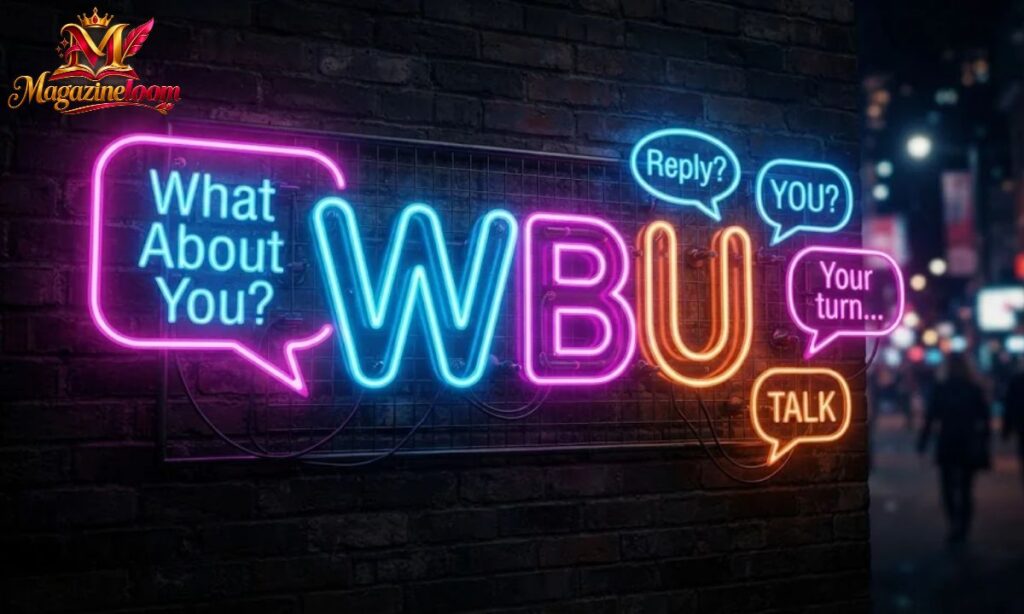
WBU meaning in text is “What About You?” People use this text abbreviation to return a question, share their side of a conversation, or keep a chat going without typing a full sentence.
You’ll often see this texting slang in text messages, Snapchat chats, Instagram DMs, and everyday conversations with friends.
Although WBU usually sounds friendly and casual, its meaning can depend on the conversation and the person sending it.
This guide explains what WBU stands for, how to respond, what it means from a crush, and how it differs from HBU, WYD, and WBY.
Quick Answer
WBU stands for “What About You?” It’s an informal abbreviation people use when they want to ask the same question back to someone.
For example:
Person A:
“I’m staying home tonight. WBU?”
Person B:
“I might go out with some friends.”
Here, the first person shares their plans and asks about the other person’s plans in return.
WBU is generally friendly and neutral, making it suitable for casual conversations, one-on-one texts, and group chats.
It isn’t usually rude or offensive, although a short reply can sometimes feel abrupt without the right context.
Why You’re Probably Looking This Up

Maybe someone replied “good, wbu” after you asked how they were doing.
Or perhaps your crush sent you “wbu?” and you’re wondering whether there’s a hidden meaning behind it.
The good news is that WBU usually has a straightforward meaning.
It’s a chat shortcut that lets someone return a question without repeating the entire sentence.
For example,
if you ask a friend what music they like, they might answer, “Mostly pop, wbu?”
They’ve answered your question and invited you to share your preferences.
However, don’t assume every WBU message carries a deeper meaning.
The surrounding conversation, your relationship with the sender, and their usual texting style provide more useful clues than three letters alone.
What WBU Actually Does in a Conversation
WBU does more than shorten a sentence.
It helps two people exchange information without making the conversation feel like an interview.
Imagine asking your friend, “How was your weekend?”
They reply, “Pretty relaxing, wbu?”
Instead of ending the conversation after answering, they return the question and give you room to share your experience.
WBU works especially well when both people have something to contribute, such as their opinions, hobbies, feelings, or daily activities.
It also keeps messages short when people are chatting quickly.
How WBU Keeps a Chat Going

A conversation can easily stall when one person answers a question without asking anything back.
WBU helps prevent that by creating a natural opening for the other person to respond.
For example:
You:
“I finally watched that new movie.”
Friend:
“Was it good? WBU, what movies do you like?”
In this example,
WBU would be more natural as a direct return question if the friend had already shared their own preference.
A clearer exchange would be:
You:
“I love comedy movies. WBU?”
Friend:
“Same here, especially the older ones.”
That small abbreviation acts as a conversational bridge, moving the discussion from one person’s interests to another’s.
When the Tone Actually Matters
WBU doesn’t have one fixed emotional tone.
In most conversations, it sounds relaxed, friendly, and neutral.
However, the same abbreviation can feel different depending on what came before it.
Consider these examples:
- Friendly: “I had a great day, wbu?”
- Interested: “I love traveling. WBU?”
- Neutral: “I’m working tomorrow, wbu?”
- Abrupt: “Fine. Wbu.”
The first three examples invite a response naturally.
The last one might feel a little cold, especially if the conversation has already been tense.
Still, short messages aren’t always signs of annoyance.
Some people naturally use brief replies, so consider their usual communication style before reading too much into the wording.
Can “WBU” Mean Something Other Than “What About You?”
In everyday texting, WBU most commonly means “What About You?”
People generally use it to ask about another person’s situation, preferences, experiences, or opinions.
For example, “I prefer tea over coffee, wbu?” asks the other person to share their preference.
The meaning is usually easy to recognize because the abbreviation appears after a statement or answer.
Outside ordinary texting, WBU can have other meanings as an acronym, depending on the organization or subject being discussed.
However, those meanings aren’t usually relevant to a casual conversation.
If someone sends WBU in a personal message, “What About You?” is the most sensible interpretation unless the surrounding context suggests otherwise.
The Most Common Meanings of “WBU Meaning in Text”
The basic definition stays the same, but the information someone wants can change with the conversation.
Here are common situations where you might see WBU.
| Context | Example | What they’re asking |
| Feelings | “I’m happy today, wbu?” | How do you feel? |
| Plans | “I’m free tonight, wbu?” | What are your plans? |
| Hobbies | “I play football, wbu?” | What hobbies do you enjoy? |
| Opinions | “I think it’s a good idea, wbu?” | What do you think? |
| Preferences | “I prefer summer, wbu?” | Which do you prefer? |
| Daily activities | “I’m studying right now, wbu?” | What are you doing? |
These examples show how wbu meaning in texting depends on the subject being discussed.
The abbreviation doesn’t replace the topic itself.
Instead, it asks the other person to respond to the same general question or share a comparable experience.
Is “WBU Meaning in Text” Rude, Flirty, or Offensive?
WBU is not inherently rude, flirty, or offensive.
It’s a neutral internet slang expression that can sound different depending on the conversation.
When a friend asks, “I’m watching a show, wbu?” they’re probably just making conversation.
When someone you’re interested in asks about your evening, they might be showing curiosity, but that doesn’t automatically mean romantic interest.
WBU can feel abrupt if someone sends it without acknowledging what you said.
For instance, if you share something important and they reply only “wbu,” the response might seem dismissive because it doesn’t address your message.
However, the issue is the conversational context, not the abbreviation itself.
What Does WBU Mean From a Crush?

If your crush texts “wbu?”, they usually want to know about your situation, feelings, plans, or preferences.
For example:
You:
“I’m staying in tonight and watching a movie.”
Your crush:
“Nice, wbu? What kind of movies do you like?”
The second message shows interest in continuing the conversation, although it doesn’t prove romantic attraction.
Look at the wider pattern instead.
Does your crush ask follow-up questions, remember things you’ve shared, and make an effort to keep talking?
Those behaviors offer more useful clues than WBU alone.
If you want to respond warmly, you could say, “Probably watching something too. Any recommendations?”
That answer shares your plans and gives the conversation somewhere to go.
How to Respond When Someone Says “WBU Meaning in Text”
The easiest way to respond to WBU is to answer the question being discussed.
You don’t need to explain the abbreviation or send a complicated reply.
For example, if someone says, “I’m good, wbu?”, you could reply, “I’m good too, thanks!”
Here are a few natural responses for different situations:
| Situation | Possible reply |
| Someone asks how you’re feeling | “I’m doing well, thanks!” |
| Someone asks about your plans | “Probably staying home tonight.” |
| Someone asks about your hobbies | “I’m really into photography.” |
| Someone shares an opinion | “I agree, actually.” |
| Your crush asks what you’re doing | “Just relaxing. What about you?” |
| You want to continue the chat | “Pretty good! Got anything planned later?” |
Your reply can be short if the conversation is casual.
If you want to keep talking, add a relevant question or detail rather than answering with just one word.
WBU Meaning in Text: The Basic Idea
The simplest way to remember WBU is to think of it as a shortened version of “What About You?”
It usually follows an answer or statement and invites the other person to share their side.
For example, “I love rainy days, wbu?” asks whether the other person feels the same way or prefers different weather.
The abbreviation doesn’t change the original question’s meaning.
It simply makes the message quicker to type, which suits the fast pace of everyday messaging.
Once you recognize that pattern, WBU becomes easy to understand in most casual conversations.
Why Do People Say WBU Instead of “What About You?”
People use WBU because short messages can make casual conversations quicker and easier.
Typing three letters instead of a full phrase saves a little time, especially during fast exchanges with friends.
It also fits the informal style people use in messaging apps and social media DMs.
For example,
someone might type “I’m from Lahore, wbu?” instead of writing “I’m from Lahore. What about you?”
Both versions communicate the same basic idea.
The full phrase may feel more natural in formal writing, while WBU works well between people who are comfortable with texting slang.
WBU in Different Types of Conversations
WBU can appear in many everyday situations because it works with different kinds of questions.
In a conversation about food, it might ask what someone likes to eat.
In a discussion about weekend plans, it might ask whether the other person is free.
The abbreviation also fits friendly chats about music, school, work, travel, and personal interests.
However, context still matters.
If someone shares difficult news, responding with only “wbu” might sound insensitive because the situation calls for a more thoughtful reply.
Use the abbreviation when it fits the conversation rather than inserting it into every exchange.
How WBU Changes the Flow of a Conversation
WBU can make a conversation feel more balanced by encouraging both people to contribute.
Without a return question, a chat may stop after one person answers.
With WBU, the other person gets an easy invitation to share something of their own.
For example:
Person A:
“I’m learning to cook these days, wbu?”
Person B:
“I’ve been trying photography lately.”
Now both people have shared an interest, creating an opportunity for a longer conversation.
That doesn’t mean WBU guarantees an engaging discussion.
The conversation still depends on whether both people respond thoughtfully and show genuine interest in what the other person says.
WBU vs WYD vs HBU: What’s the Difference?
WBU, HBU, and WYD are common texting abbreviations, but they don’t mean the same thing.
WBU means “What About You?”, while HBU means “How About You?” and WYD means “What You Doing?”
WBU and HBU often serve similar purposes because both can return a question.
WYD usually asks what someone is doing, either at that moment or in a context where their activities are relevant.
| Abbreviation | Full form | Main purpose |
| WBU | What About You? | Ask about the other person’s situation |
| HBU | How About You? | Return a question |
| WYD | What You Doing? | Ask what someone is doing |
| WBY | What About You? | An alternative short form |
For example,
“I’m tired, wbu?” asks how the other person feels.
“I’m tired, hbu?” can serve the same purpose.
“WYD?” asks about someone’s activity instead.
WBU or WBY: Which Is Correct?
WBU and WBY are both used informally to mean “What About You?”
WBU is a widely recognized form in everyday texting, while WBY appears in some online conversations as an alternative.
Neither abbreviation is appropriate for every setting, and neither is a substitute for the full phrase in formal writing.
If you’re unsure which one the other person understands, write “What about you?” instead.
It’s clear, natural, and unlikely to cause confusion.
WBU Meaning in Urdu
WBU کا مطلب ہے “What About You?” یعنی “اور آپ؟” یا “اور تم؟”
یہ abbreviation عام طور پر چیٹ یا ٹیکسٹ میسج میں کسی سے وہی سوال واپس پوچھنے کے لیے استعمال ہوتی ہے۔
مثال کے طور پر:
Person A: “I’m fine, wbu?”
اردو مطلب: “میں ٹھیک ہوں، اور تم؟”
اسی طرح، اگر کوئی کہے “I like cricket, wbu?”, تو اس کا مطلب ہوگا، “مجھے کرکٹ پسند ہے، اور تمہیں؟”
WBU عام طور پر دوستوں، جاننے والوں اور سوشل میڈیا پر غیر رسمی گفتگو میں استعمال ہوتا ہے۔
رسمی پیغام میں “What about you?” لکھنا زیادہ مناسب رہتا ہے، کیونکہ اس کا مطلب ہر قاری آسانی سے سمجھ سکتا ہے۔
Is WBU Formal or Informal?
WBU is an informal abbreviation designed for casual communication.
It’s suitable for conversations with friends, relatives, classmates, and people who regularly use texting slang.
You can use it in text messages, social media comments, and relaxed online discussions.
However, avoid it in formal emails, job applications, official letters, or professional messages where clear wording matters.
For example,
instead of writing “I’m available on Friday, wbu?” in a formal work email, write “I’m available on Friday. Does that work for you?”
The full phrase or a complete question usually makes your message clearer and more professional.
Is WBU Friendly or Too Casual?

WBU usually sounds friendly when the conversation is relaxed and both people use abbreviations.
For example,
“I’m going shopping later, wbu?” sounds like a normal message between friends.
It can also feel neutral when two people are getting to know each other.
However, someone who prefers complete sentences may find abbreviations too casual.
If you’re messaging a new acquaintance, pay attention to how they write and match their style naturally.
You don’t need to use every abbreviation they use, though.
Clear communication matters more than matching someone’s texting habits perfectly.
How to Use WBU Naturally
The easiest way to use WBU is to place it after a short answer or statement when you want the other person to share their side.
For example, “I prefer tea, wbu?” works because the other person can easily respond with their preference.
You can also use it after talking about plans, feelings, or hobbies.
Try these simple guidelines:
- Use WBU when returning a question.
- Keep it for casual conversations.
- Make sure the context makes your meaning clear.
- Add a follow-up question when you want to continue talking.
- Use the full phrase when writing to someone who may not recognize texting slang.
Avoid adding WBU to a message when you don’t actually want an answer.
A natural conversation feels better when your questions relate to what the other person has shared.
WBU in Text Messages
In text messages, WBU often appears at the end of a sentence or after a short answer.
For example,
“I’m free this weekend, wbu?” asks whether the other person is also available.
You might also see “Good, wbu?” after someone asks how you’re doing.
The abbreviation works best when both people understand casual texting conventions.
Capitalization doesn’t usually change its meaning, so WBU and wbu generally communicate the same thing.
Punctuation can affect how the message feels, but the surrounding words usually provide the clearest indication of tone.
WBU on Snapchat, Instagram, and Social Media
WBU is common in casual online conversations, including Snapchat messages, Instagram DMs, and other social media chats.
Someone might use it after sharing a photo, discussing a weekend plan, or talking about a favorite activity.
For example,
a friend could send “I’m listening to music rn, wbu?” to ask what you’re doing.
The abbreviation works much the same way across platforms.
However, don’t assume it has a special meaning on Snapchat or Instagram simply because it appears there.
It’s generally the same familiar question, shortened for quick messaging.
Can WBU Sound Flirty?
WBU can appear in a flirty conversation, but the abbreviation itself isn’t romantic.
Its tone depends on the message surrounding it and the relationship between the people chatting.
For example,
“I’m free tonight, wbu?” could be a simple question about plans.
If the person has also been teasing you, asking thoughtful questions, or suggesting that you meet, the message might carry a more playful tone.
Still, one abbreviation isn’t enough to determine someone’s intentions.
Look at the conversation as a whole rather than treating WBU as a hidden romantic signal.
WBU vs HBU: Are They the Same?
WBU and HBU are very similar because both can return a question to the other person.
WBU stands for “What About You?”, while HBU stands for “How About You?”
In many everyday conversations, either abbreviation works naturally.
For example:
Person A:
“I love action movies, wbu?”
Person B:
“I prefer comedies, hbu?”
Both people are asking about the other’s preference.
The difference is mainly in the wording, not a major change in meaning.
Other Meanings of WBU
Although “What About You?” is the usual meaning of WBU in casual texting, abbreviations can have different meanings in specialized settings.
For example,
an organization, school, or online community might use the same letters as an internal acronym.
That doesn’t mean those alternative definitions apply to ordinary messages.
If you see WBU in a personal chat, start with the common texting meaning and check whether the sentence supports it.
If the abbreviation appears in a work document or a discussion about a specific organization, ask for clarification rather than assuming the same definition applies.
Common Mistakes When Using WBU

WBU is easy to use, but a few mistakes can make a message confusing or awkward.
The most common is assuming that every person knows texting abbreviations.
Another mistake is using WBU in a formal email or a serious conversation where a complete response would be more appropriate.
Keep these points in mind:
- Don’t confuse WBU with WYD. WBU asks about the other person, while WYD asks what they’re doing.
- Don’t assume WBU means flirting. It usually works as a neutral question.
- Don’t force it into every message. Use it when returning a question makes sense.
- Don’t rely on abbreviations in formal writing. Spell out the phrase when clarity matters.
- Don’t ignore context. The surrounding conversation helps explain what the sender wants to know.
Using WBU naturally is more about timing and context than memorizing a set of rules.
Frequently Asked Questions
What does WBU mean in text?
WBU means “What About You?” It’s an informal abbreviation used to return a question or invite someone to share their thoughts, plans, or experiences.
What does “good, wbu” mean?
“Good, wbu?” means “I’m good. What about you?” The sender is answering your question and asking how you’re doing in return.
What does WBU mean from a girl?
When a girl sends WBU, she usually wants to know about your situation, opinion, or plans. It can be friendly or conversational, but it doesn’t automatically mean she’s flirting.
What does WBU mean from a guy?
When a guy texts WBU, he generally means “What About You?” The message may show ordinary interest in the conversation, but its romantic meaning depends on the wider context.
How do you reply to WBU?
Answer the question being discussed. If someone says “I’m good, wbu?”, you could reply, “I’m doing well too, thanks!” Add a question if you want to keep talking.
Is WBU rude?
No, WBU isn’t inherently rude. It usually sounds casual and friendly, although a very short reply may feel abrupt in some situations.
Can I use WBU in a professional message?
It’s best to avoid WBU in formal professional messages. Write the full phrase or ask a clear question instead, especially when contacting clients, managers, or people you don’t know well.
What is the difference between WBU and HBU?
WBU means “What About You?”, while HBU means “How About You?” Both can return a question, and they’re often interchangeable in casual conversations.
What does WBU mean in Urdu?
WBU کا مطلب ہے “اور تم؟” یا “اور آپ؟” یہ کسی دوسرے شخص سے وہی سوال واپس پوچھنے کے لیے استعمال ہوتا ہے۔
Final Thought
Now you know what WBU means. It stands for “what about you?” People use it to ask the same question back. This guide on WBU Meaning in Text: Definition, Uses & Examples showed you how simple it is. You also saw where to use it. It works well in texts, group chats, and social media apps.
The tone is usually friendly and casual. With the right emojis, it can even sound a little flirty. Just don’t send a lone “WBU?” with no context. It can feel abrupt. Skip it in formal emails too. Write “what about you?” instead.
When someone sends WBU, they want to hear your side. So share a quick answer and keep the chat going. Try it in your next conversation. It takes only a second to type. It is a small shortcut that makes talking easier.

Noah is a passionate content writer and language enthusiast who enjoys making difficult words, phrases, and text meanings easy to understand. She creates clear, simple, and useful articles with practical examples to help readers improve their vocabulary and everyday language skills.