Have you ever received a message saying “GTG” and wondered what the person meant?
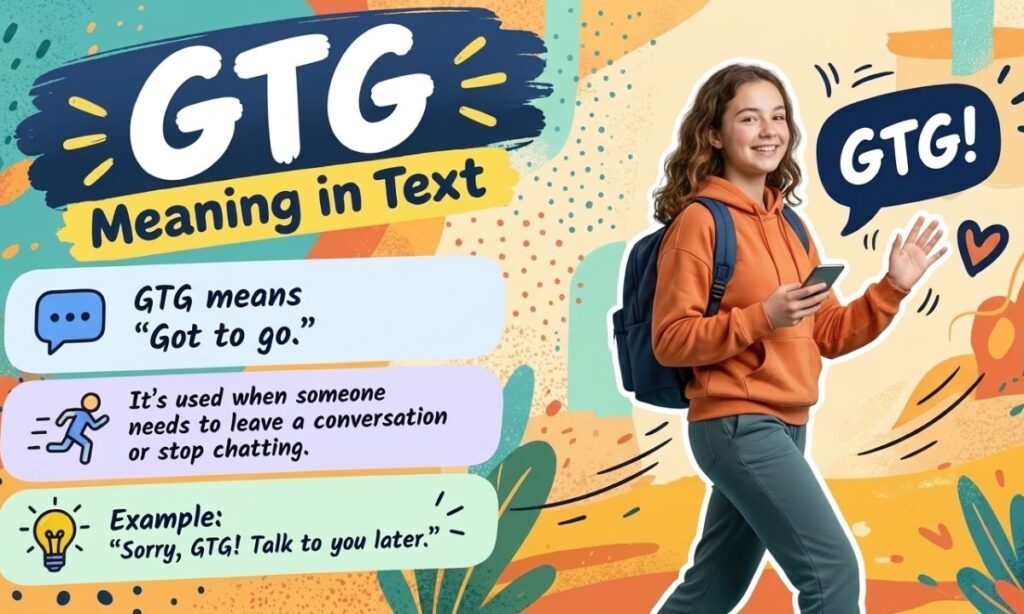
In everyday texting, GTG meaning in text usually refers to “Got to Go,” a quick way to tell someone you need to leave or end a conversation.
People use this texting abbreviation with friends, family, classmates, and online gaming partners when they need to go somewhere or get back to something.
However, GTG can also mean “Good to Go,” so the surrounding conversation helps you understand its intended meaning.
Quick Answer
GTG stands for “Got to Go” in most casual text conversations.
It tells the other person that you need to leave, stop chatting, or attend to something else.
For example, if your friend texts, “GTG, dinner is ready,” they mean they need to leave the conversation because dinner is waiting.
In other situations, especially when discussing plans, GTG can mean “Good to Go,” which means ready or prepared.
What Does “GTG” Mean in Text?

The most common GTG meaning in chat is “Got to Go.”
It’s an informal abbreviation that helps people communicate quickly without typing a complete sentence.
You might see GTG in text messages, social media messages, gaming chats, or group conversations.
For example, “GTG now, I’ll message you tomorrow” tells the recipient that the conversation needs to end for now.
What Does GTG Mean in Text and Chat?
In texting and online chats, GTG usually signals that someone is leaving.
It can communicate urgency, a busy schedule, or simply the end of a conversation.
The meaning depends on the context.
If someone says, “GTG, my class is starting,” they need to leave, but if they say, “Everything’s GTG,” they probably mean everything is ready to go.
What Does “Got to Go” Mean in Simple Words?
“Got to Go” means “I need to leave now” or “I have something else to do.”
It’s a quick way to explain why you can’t continue talking at that moment.
Imagine you’re chatting with a friend when your phone rings and your ride arrives.
You could simply write, “GTG, my ride is here,” instead of explaining the whole situation.
Why People Use GTG in Texting
People use GTG slang because it’s short, familiar, and easy to type.
When a conversation is moving quickly, three letters can communicate a complete message.
GTG also helps people leave a chat without ignoring the other person.
Adding a few words, such as “GTG, talk tomorrow,” makes the message clearer and friendlier.
Common reasons people use GTG include:
- They need to leave for school, work, or an appointment.
- They have another task to finish.
- They want to end a conversation politely.
- They need to stop playing an online game.
- They want to let someone know they’ll respond later.
Is GTG Formal or Informal?

GTG is informal, so it’s best suited to casual conversations.
It’s generally fine when texting friends, siblings, classmates, or people who already use similar abbreviations.
However, avoid GTG in formal business emails, official documents, or messages to someone who expects professional language.
Instead of writing “GTG, meeting starts now,” you could say, “I need to join my meeting now. I’ll follow up later.”
How to Use GTG Correctly in Sentences
To use GTG correctly, place it where you’d naturally tell someone you’re leaving.
You can write it at the beginning of a message, followed by a reason, or at the end of a conversation.
Here are a few examples of GTG in a sentence:
- “GTG, my bus is here.”
- “It’s getting late, so GTG.”
- “GTG now, but I’ll call you tonight.”
- “Sorry, GTG. My class is starting.”
- “GTG, see you tomorrow!”
You don’t need to explain yourself every time.
However, adding a short reason or a friendly goodbye can make your message easier to understand.
Common Situations Where People Use GTG
GTG fits situations where you need to leave quickly or stop responding.
It’s especially common in fast texting conversations where people don’t expect lengthy explanations.
For example, you might use GTG when leaving a family group chat, finishing a conversation with a classmate, or stepping away from an online game.
The abbreviation works best when the other person understands casual texting language.
Real-Life Examples of GTG in Conversations

These GTG examples show how the abbreviation works in everyday messages.
Example 1:
Chatting with a friend
Friend A:
“Are you coming to the park later?”
Friend B:
“Yes! GTG for now, I’ll text you after lunch.”
Here, GTG means the person needs to leave the conversation temporarily.
Example 2:
Talking to a classmate
Classmate A:
“Did you finish the assignment?”
Classmate B:
“Almost, but GTG. The teacher is coming.”
The message explains why the conversation must stop.
Example 3:
Messaging a family member
Sibling A:
“Can you help me with dinner?”
Sibling B:
“GTG to the kitchen now!”
In this example, the person is leaving what they’re doing to help.
Example 4:
Chatting online
Friend A:
“One more round?”
Friend B:
“Can’t, GTG. I’ll play tomorrow.”
The sender needs to stop playing, but they also suggest when they might return.
When You Should Avoid Using GTG
Although GTG is common in casual messaging, it doesn’t fit every situation.
Some people may not recognize the abbreviation, especially if they rarely use texting slang.
Avoid using it when writing formal emails, contacting a new client, or sending an important message to someone unfamiliar with abbreviations.
A clear sentence is usually better when the conversation involves deadlines, instructions, or professional responsibilities.
For example, “GTG, send the file later” could sound unclear in a work conversation.
Instead, write, “I need to leave now, but I’ll send the file by 3 p.m.”
Common Mistakes People Make with GTG
One common mistake is assuming GTG always means “Got to Go.”
In conversations about plans or readiness, it can mean “Good to Go” instead.
Another mistake is using GTG in situations where the other person needs a clear explanation.
A short abbreviation may be convenient, but it shouldn’t replace important details.
Keep these points in mind:
- GTG usually means “Got to Go” in casual chats.
- GTG can mean “Good to Go” when discussing readiness.
- The abbreviation is informal, not a good fit for every professional message.
- It doesn’t automatically mean someone is annoyed or wants to avoid you.
- A little context can prevent confusion.
Similar Slang Terms Like GTG in Texting
Several other texting slang terms serve a similar purpose.
Some tell someone you’re leaving, while others explain that you’ll return or respond later.
Here are a few common examples:
| Abbreviation | Full form | Meaning |
| BRB | Be Right Back | I’ll return shortly. |
| TTYL | Talk to You Later | We’ll talk another time. |
| G2G | Got to Go | A spelling variant of GTG. |
| BBL | Be Back Later | I’ll return later. |
| AFK | Away From Keyboard | I’m temporarily unavailable. |
| TTFN | Ta-Ta for Now | A casual goodbye. |
These expressions aren’t completely interchangeable.
For instance, BRB suggests a return soon, while GTG usually signals that someone needs to leave.
GTG vs BRB vs TTYL: Key Differences Explained
GTG, BRB, and TTYL all appear in casual online conversations, but each communicates something different.
Choosing the right one helps the other person understand whether you’re leaving, returning, or ending the conversation for now.
| Term | Meaning | When to use it |
| GTG | Got to Go | You need to leave now. |
| BRB | Be Right Back | You’ll return shortly. |
| TTYL | Talk to You Later | You’ll talk again later. |
For example, write “BRB, someone’s at the door” if you expect to return shortly.
Use “GTG, my train is here” when you need to leave, or “TTYL, I’ll message you tomorrow” when ending the conversation.
How People Use GTG on Social Media and Gaming Apps
People use GTG across social media messages and online chats to announce that they’re leaving.
The meaning generally stays the same, although the situation can influence how the message sounds.
On Snapchat, Instagram, and WhatsApp, someone might write “GTG, talk later” before leaving a conversation.
In gaming chats, players may use it when they need to quit a match or stop playing.
The abbreviation doesn’t have a separate universal meaning on each platform.
If you’re unsure, read the surrounding messages before deciding what the sender means.
GTG for Beginners: Simple Explanation
If you’re new to texting abbreviations, remember one simple rule: GTG usually means “Got to Go.”
Someone using it is telling you they need to leave or stop chatting.
For example, if your friend writes, “GTG, mom’s calling,” they’re probably ending the conversation because they need to respond.
You can reply with “Okay, talk later!” without worrying that you’ve missed something complicated.
GTG Full Form: What Does It Stand For?
The GTG full form depends on the conversation.
Its two widely understood meanings are “Got to Go” and “Good to Go.”
The first meaning concerns leaving or ending a chat.
The second concerns readiness, such as being prepared for a trip, meeting, or activity.
GTG as “Got to Go”
“Got to Go” is the common meaning in everyday texting.
It lets someone know that they can’t continue the conversation right now.
For example, “GTG, my appointment starts in five minutes” explains why the sender is leaving.
It’s a quick, natural way to end a casual conversation without writing a long goodbye.
GTG as “Good to Go”
“Good to Go” means ready, prepared, or able to proceed.
People may use it when discussing plans, arrangements, or whether something is ready.
For example, someone might ask, “Are we GTG for the trip?”
A reply such as “Yep, we’re GTG” means everything is ready.
The surrounding words usually make the intended meaning clear.
If someone says they’re GTG after packing their bags, they probably mean they’re ready rather than leaving a chat.
How Do You Reply When Someone Says GTG?
Your reply depends on the conversation and your relationship with the sender.
You don’t need to make the exchange complicated.
Here are some natural replies:
- “Okay, talk later!”
- “No worries, catch you tomorrow.”
- “Alright, take care!”
- “See you soon!”
- “Okay, message me when you’re free.”
If the person means “Good to Go,” you could respond with “Great, let’s do it!”
Pay attention to the context so your reply matches the intended meaning.
Is It Rude to Say GTG?
No, saying GTG isn’t automatically rude.
It’s a common shorthand for letting someone know they need to leave a conversation.
However, the tone and timing can affect how the message feels.
Sending only “GTG” during a serious conversation may seem abrupt, especially if the other person expects a response.
If you want to sound considerate, add a brief explanation or goodbye.
For example, “GTG for now, but let’s finish this conversation tonight” feels clearer than abruptly disappearing.
GTG Military Meaning
In military settings, abbreviations can have specialized meanings depending on the unit, document, or communication system.
However, GTG doesn’t have one universal military expansion that applies to every situation.
In an informal message, a military service member might use GTG in its ordinary texting sense, meaning “Got to Go.”
For official instructions or operational communication, don’t assume its meaning without checking the relevant glossary or asking the sender.
GTG Meaning in Trucking
In trucking conversations, GTG may be used informally to mean “Got to Go” or “Good to Go.”
For example, a driver chatting with a colleague might use it to say they need to leave or that they’re ready to depart.
However, trucking terminology can vary between companies, dispatch systems, and regions.
Don’t treat GTG as a standardized trucking code without a reliable source confirming its meaning in that specific context.
Tips to Use GTG Correctly in Conversations

Using GTG naturally is easy once you understand the situation.
The main goal is to communicate clearly without making the other person guess what you mean.
Follow these tips:
- Use GTG with friends and people who understand casual abbreviations.
- Add a reason when the conversation needs more context.
- Use “Good to Go” when discussing readiness, if the meaning isn’t obvious.
- Choose a complete sentence for business emails or formal communication.
- Add “talk later” or “see you soon” when you want to end the conversation warmly.
You can also use G2G as a spelling variant of GTG.
Both commonly communicate “Got to Go,” although the exact wording still depends on context.
Does GTG Mean Something Different From a Girl or Guy?
The GTG meaning from a girl or guy is generally the same.
It usually means “Got to Go,” regardless of who sends the message.
If someone texts “GTG, talk later,” it doesn’t automatically mean they’re upset, uninterested, or trying to avoid you.
They may simply be busy, leaving home, or finishing a task.
Look at the broader conversation rather than guessing someone’s feelings from three letters.
Their usual texting habits and the context provide better clues than gender alone.
Why Understanding GTG Improves Your Communication
Understanding common abbreviations makes online conversations easier to follow.
When you know what GTG means, you can recognize when someone needs to leave and respond appropriately.
It also helps you choose language that suits the situation.
You can use GTG with friends while switching to clearer wording for clients, teachers, or important professional messages.
Frequently Asked Questions
What does GTG mean in a text message?
GTG usually means “Got to Go” in a text message.
It tells the recipient that the sender needs to leave or stop chatting.
What does GTG mean from a girl?
GTG generally means “Got to Go” when a girl uses it.
The abbreviation alone doesn’t reveal romantic interest, frustration, or any other specific emotion.
What does GTG mean from a guy?
When a guy texts GTG, he usually means “Got to Go.”
The exact intention depends on the conversation, not the sender’s gender.
Does GTG mean good to go?
Yes, GTG can mean “Good to Go.”
This meaning usually appears when people discuss whether a person, plan, or task is ready.
Is GTG the same as G2G?
GTG and G2G are common variants used to mean “Got to Go.”
The preferred spelling may vary between individuals and online communities.
Is GTG rude in texting?
GTG isn’t inherently rude, but a message containing only those letters can feel abrupt.
Adding a short explanation or friendly goodbye can make the message warmer.
How do you respond to GTG?
You can reply with “Okay, talk later,” “Take care,” or “See you soon.”
If the person means “Good to Go,” respond according to the plan or activity being discussed.
Can I use GTG in a professional email?
It’s better to avoid GTG in formal or unfamiliar professional settings.
Use a clear sentence such as “I need to leave now, but I’ll follow up tomorrow.”
Final Thought
GTG usually stands for “Got to Go” and helps people end casual conversations quickly.
It can also mean “Good to Go” when someone talks about being ready for a plan or activity.
Use it naturally with friends and familiar contacts, but choose clear language when the situation calls for it.
Once you understand the context, this simple texting abbreviation becomes easy to recognize and use.

Noah is a passionate content writer and language enthusiast who enjoys making difficult words, phrases, and text meanings easy to understand. She creates clear, simple, and useful articles with practical examples to help readers improve their vocabulary and everyday language skills.