
Many writers mix up “unaccessible” vs “inaccessible.” Both look right at first. But only one is correct in standard English. Let’s clear up the confusion.“Inaccessible” is the correct word. It means something cannot be reached, entered, or used. For example, a locked room or a broken website is inaccessible. People often search for “unaccessible vs.
inaccessible” because the two words sound so alike.“Unaccessible” is rarely used and is usually seen as a mistake. Most dictionaries do not list it as a standard word. So when you compare unaccessible vs. inaccessible, always choose “inaccessible” in your writing.
It isn’t. “Inaccessible” is the correct standard English word. “Unaccessible” is a non-standard form that most dictionaries do not list, and editors will usually mark it as an error.This guide explains the difference, why the confusion happens, and how to pick the right word every time.
Quick Answer
Use “inaccessible.” It means something that cannot be reached, entered, used, or understood. “Unaccessible” is not accepted in standard English, so avoid it in school, business, academic, and professional writing.
- ✅ The mountain village is inaccessible during winter.
- ❌ The mountain village is unaccessible during winter.
Quick Overview Table
| Feature | Inaccessible | Unaccessible |
| Correct in standard English? | Yes | No |
| Found in major dictionaries? | Yes | Rarely or not at all |
| Part of speech | Adjective | Treated as an adjective, but non-standard |
| Opposite of | Accessible | Accessible |
| Safe for formal writing? | Yes | No |
| Verdict | Use it | Avoid it |
Unaccessible vs. Inaccessible at a Glance
| Point | Inaccessible | Unaccessible |
| Meaning | Unable to be reached, entered, or used | Same intended meaning |
| Prefix | in- (Latin origin) | un- (Germanic origin) |
| Spelling status | Standard | Non-standard / error |
| Typical contexts | Locations, websites, data, services | Mostly typos and informal writing |
| Example | “The files were inaccessible.” | “The files were unaccessible.” (incorrect) |
Why Unaccessible vs. Inaccessible Confuses So Many Writers
Several things make this pair tricky.
1.English has two common negative prefixes.
Writers know both un- and in-, and sometimes the wrong one slips in.
2.“Un-” feels natural.
We say unable, unavailable, unreachable, and unreliable, so unaccessible sounds like it belongs in the family.
3.Spellcheck is not always helpful.
Some tools flag unaccessible, but others let it pass, especially in informal text.
4.The words around it look alike.
“Accessible,” “access,” “accessibility,” and “inaccessibility” all share one root, which makes the prefix easy to mix up.
No simple rule is taught in school.
Most people learn prefix choices by ear, and the ear can be wrong.
The good news is that the correct choice follows a pattern, which we cover below.
What Does “Inaccessible” Mean?
Inaccessible is an adjective that describes something that cannot be reached, entered, approached, used, or understood. It is the direct opposite of accessible.
The word works in both literal and figurative ways:
- Literal: a place you cannot physically get to.
- Digital: a file, account, or website you cannot open.
- Figurative: an idea or explanation too complex to follow.
Example Sentences
- Heavy snow left the mountain pass inaccessible to vehicles.
- The older building is inaccessible to wheelchair users.
- Her account became inaccessible after too many failed login attempts.
- The research paper was so technical that it felt inaccessible to general readers.
- Several websites were inaccessible during the server outage.
Dictionary Definition and Pronunciation
- Word: inaccessible
- Part of speech: adjective
- Syllables: in-ac-ces-si-ble (five syllables)
- Pronunciation (IPA): /ˌɪn.əkˈsɛs.ə.bəl/
- Simple pronunciation: in-ak-SESS-uh-bul
- Definition: not able to be reached, entered, used, or understood
- Noun form: inaccessibility
- Adverb form: inaccessibly
What Does “Unaccessible” Mean?
“Unaccessible” is meant to say the same thing as “inaccessible,” but it is not recognized as standard English. It appears in casual typing, social media posts, and the writing of people still learning English. It is occasionally listed in a few online references as a rare or non-standard variant.
You may see it used in places such as:
- Quick text messages and chat.
- Machine-translated text.
- Forum posts and comments.
- Informal product reviews.
Even where people understand it, it can make your writing look careless.
Example Comparison
| Incorrect | Correct |
| The cave is unaccessible to tourists. | The cave is inaccessible to tourists. |
| My email became unaccessible. | My email became inaccessible. |
| The data is unaccessible without a password. | The data is inaccessible without a password. |
| The tool felt unaccessible to beginners. | The tool felt inaccessible to beginners. |
Is “Unaccessible” Found in Dictionaries?
Major English dictionaries list “inaccessible” as the standard entry. Established dictionaries such as Merriam-Webster, Oxford, Cambridge, and Collins define it clearly and give plenty of examples.
“Unaccessible” is generally not given as a headword in these mainstream references. At most, it shows up in open or user-edited resources as a rare, non-standard form. Dictionaries change over time, so you can always check a current edition, but as of now you should treat it as an error.
The practical rule: if a word is not in the standard dictionary and a standard alternative exists, use the standard one.
Grammar Insight: Why “Inaccessible” Is Correct
The answer comes down to the word’s origin.
“Accessible” comes from Latin (accessibilis, from accedere, “to approach”). English borrowed many Latin-based adjectives, and when it needed their opposites, it usually used the Latin-style prefix in- (meaning “not”).
The un- prefix, by contrast, comes from Old English. It tends to attach to native English words or to words that have been in the language for a very long time.
This is a strong tendency rather than a hard law, but it explains why we say:
- inaccessible, not unaccessible
- invisible, not unvisible
- incapable, not uncapable
- indirect, not undirect
Examples
- Latin-rooted adjective + in-:
- inadequate, inaudible, inconsistent, inaccurate, inaccessible
- Germanic-rooted adjective + un-:
- unhappy, unkind, unfair, unclear, unsafe
When you see a longer, more formal adjective with a Latin feel, such as accessible, audible, or visible, in- is usually the right negative.
Real-Life Usage Examples

Here is how inaccessible appears in everyday situations.
Physical Access
- The island is inaccessible by road.
- The upper floor is inaccessible to people who cannot climb stairs.
- Flooding made the trail inaccessible for hikers.
Technology
- The server crashed, and the website became inaccessible.
- Encrypted files stay inaccessible without the right key.
- The app was inaccessible from outside the country.
Communication
- His writing style was inaccessible to casual readers.
- The legal contract was full of inaccessible jargon.
- The manager seemed inaccessible, so staff stopped bringing problems to her.
Emergency Situations
- Rescuers struggled to reach the inaccessible area after the landslide.
- Fallen trees left several neighborhoods inaccessible to ambulances.
- Hospitals warned that some roads were inaccessible because of flooding.
Common Mistakes to Avoid
Writers tend to make the same few slips with this word.
Common errors include:
Using “unaccessible” instead of “inaccessible.”
This is the biggest mistake.
Mixing up “inaccessible” and “inaccessable.”
The ending is -ible, not -able.
Confusing it with “inadmissible.”
That word means “not allowed,” especially in court.
Misspelling it as “innaccessible.”
There is only one n after the i.
Using “inaccessibility” as an adjective.
It is a noun, so say “inaccessible roads,” not “inaccessibility roads.”
When NOT to Use “Unaccessible”
Do not use it in:
- Academic essays and research papers.
- Business emails and reports.
- Websites, product pages, and marketing copy.
- Legal, medical, and technical documents.
- Resumes, cover letters, and applications.
- Any writing that will be published or graded.
Using the wrong form in these places can hurt your credibility, and it can also hurt your search performance if the page targets the correct spelling.
Similar Words to “Inaccessible”
Several other words share the in- pattern or a similar meaning. Learning them together helps the rule stick.
| Word | Meaning |
| Inaudible | Cannot be heard |
| Invisible | Cannot be seen |
| Inadmissible | Not allowed, especially as evidence |
| Inaccurate | Not correct |
| Incompatible | Cannot work together |
| Impassable | Cannot be traveled through |
| Unreachable | Cannot be contacted or arrived at |
| Unavailable | Not ready or not able to be used |
Notice that unreachable and unavailable are perfectly correct. They are formed from native-feeling roots, which is why un- works there but not with accessible.
Why This Difference Matters
It may seem small, but the right word choice has real effects.
Credibility:
one spelling slip can make a reader doubt the rest of your work.
Clarity:
standard words are understood by everyone, including translation tools and screen readers.
Professionalism:
employers, teachers, and clients notice small errors.
SEO performance:
people search for the standard word, so using it helps your content match real queries.
Advanced Insight: Word Formation
Linguists call the process of adding a prefix to a base word derivation. English has a long history of borrowing words from Latin and French, and those words arrived with their own patterns.
The in- prefix also changes shape depending on the letter that follows. This is called assimilation.
| Prefix form | Used before | Examples |
| in- | most letters (c, d, s, v, etc.) | inaccessible, indirect, invisible |
| im- | b, m, p | impossible, immature, imbalance |
| il- | l | illegal, illogical |
| ir- | r | irregular, irrelevant |
Because “accessible” begins with a, the plain in- form is used, giving us inaccessible.
One more subtle point: in- can also mean “inside” or “into,” as in inside or include. In inaccessible it carries the negative sense, so context makes the meaning clear.
Common Contexts Where “Inaccessible” Is Correct
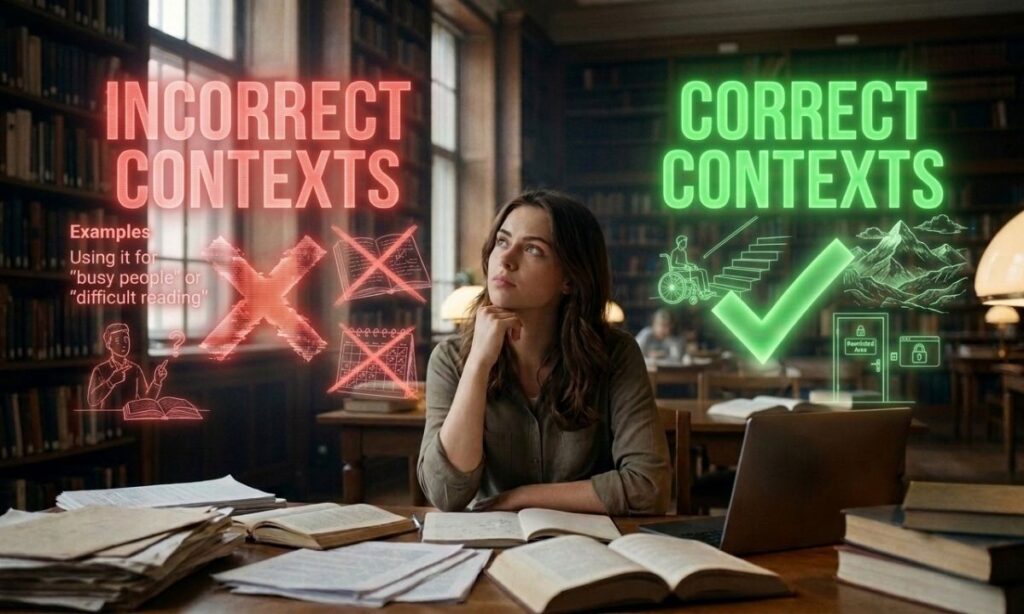
Physical Access
Use inaccessible when location or structure blocks entry.
- A remote cabin with no road.
- A building with no ramp or elevator.
- A cave sealed by rockfall.
Technology and Websites
Use it when a system, page, or file cannot be opened or used.
- A website down for maintenance.
- A database locked behind permissions.
- A page blocked by a firewall or region restriction.
Digital Accessibility and Disability Access
In this field, inaccessible describes products and spaces that exclude people with disabilities.
- A website with no alt text is inaccessible to screen reader users.
- Videos without captions are inaccessible to deaf and hard-of-hearing viewers.
- A form that cannot be completed with a keyboard is inaccessible to users who cannot use a mouse.
Standards such as the Web Content Accessibility Guidelines (WCAG) exist to help designers avoid creating inaccessible content.
Communication and Information
Use it when language or presentation is too difficult to follow.
- A report packed with jargon.
- Instructions written without clear steps.
- Academic writing that general audiences cannot parse.
Emergency Situations
Use it when disaster or damage blocks routes and services.
- Roads washed out by floods.
- Areas cut off by earthquakes or storms.
- Zones that responders cannot enter safely.
Synonyms for Inaccessible (With Context)
Choosing a synonym can make your writing less repetitive. Pick the one that fits the situation.
| Synonym | Best used when | Example |
| Unreachable | A place or person can’t be contacted or arrived at | The village was unreachable by car. |
| Out of reach | Something is physically or practically beyond grasp | The top shelf was out of reach. |
| Off-limits | Entry is forbidden | The lab is off-limits to visitors. |
| Impassable | A route can’t be traveled | The snowy road was impassable. |
| Unavailable | A resource is not ready to use | The service is unavailable right now. |
| Remote | A place is far from others | A remote mountain lodge. |
| Blocked | Something obstructs entry | The entrance was blocked. |
| Incomprehensible | Hard to understand | The manual was incomprehensible. |
| Unapproachable | A person seems cold or hard to talk to | His boss seemed unapproachable. |
Note that not every synonym fits every context. Impassable only works for routes, and unapproachable mostly describes people.
Is “Unaccessible” Ever Acceptable in Modern English?
In almost every case, no.
Language does evolve, and some once-incorrect forms become accepted. But “unaccessible” has not gained that status in standard references. A few situations may show it:
- Quoted speech or dialogue in fiction, where a character might use it.
- Direct quotations from another source that you must reproduce exactly.
- Discussions about the word itself, like this article.
Outside of these narrow cases, replace it with inaccessible. If you want a safe alternative, you can also use unreachable, unavailable, or out of reach, depending on your meaning.
Word Formation: How “In-” and “Un-” Prefixes Differ
Both prefixes mean “not,” but they behave differently.
| Feature | In- | Un- |
| Origin | Latin | Old English |
| Common base words | Latin or French-derived adjectives | Native English words and many others |
| Examples | inaccessible, inaudible, incomplete | unhappy, unlucky, unfinished |
| Spelling changes | Yes (im-, il-, ir-) | No |
| Typical tone | Formal | General |
Important note:
this is a tendency, not a strict law. English has exceptions such as uncomfortable (Latin-rooted with un-) and incurious. When in doubt, check a dictionary rather than guessing.
For accessible, the dictionary answer is clear: the opposite is inaccessible.
Why Using the Correct Word Matters
Think of word choice as a trust signal. Readers rarely praise correct spelling, but they almost always notice mistakes.
Here is what correct usage gives you:
- Stronger authority: your writing looks careful and informed.
- Better readability: standard words cause no hesitation.
- Accessibility compliance: when you write about inclusive design, using the correct term shows you understand the field.
- Improved search visibility: content aligned with real search terms tends to perform better.
For students, it can mean better grades. For professionals, it can mean a cleaner brand image.
Simple Tips to Remember the Correct Spelling
Try these quick memory tricks.
Match the pair. Think “accessible → inaccessible,” just like “audible → inaudible” and “visible → invisible.”
Remember the “-ible” ending. Say it aloud: in-ac-ces-si-ble.
Use the Latin shortcut. If an adjective ends in -ible or -able and sounds formal, in- is often the right negative.
Substitute and test. Try “in-” with a similar word, such as “invisible.” If unvisible sounds wrong, so does unaccessible.
Keep a mini checklist. Before publishing, scan for -ible, a single n, and the in- prefix.
Run a final spellcheck. Then read the sentence aloud to catch awkward forms.
Formal vs Informal Writing: What Should You Use?
| Writing type | Recommended word |
| Academic essays | inaccessible |
| Business emails | inaccessible |
| Reports and proposals | inaccessible |
| Blog posts and articles | inaccessible |
| Website and product copy | inaccessible |
| Casual texts | inaccessible (still best) |
| Fiction dialogue (stylistic) | “unaccessible” only if deliberate |
Even in casual messages, inaccessible is the better habit. Using it everywhere means you never have to think about the context.
Quick Decision Rule You Can Always Trust
Ask yourself one question:
Does the word describe something that can’t be reached, entered, used, or understood?
If yes, write inaccessible.
If you aren’t sure, run this three-step check:
- Look at the base word: accessible.
- Pick the standard opposite: inaccessible.
- Confirm it in a trusted dictionary.
That is all you need.
Frequently Asked Questions
Is “unaccessible” a real word?
Not in standard English. It is a non-standard form that most dictionaries do not list, so use “inaccessible” instead.
What is the correct spelling: inaccessible or inaccessable?
Inaccessible is correct. The word ends in -ible, not -able.
What is the opposite of inaccessible?
The opposite is accessible, meaning able to be reached, entered, used, or understood.
Can I use “unaccessible” in formal writing?
No. Formal writing calls for the standard word, so always use “inaccessible.”
Why do we say “inaccessible” and not “unaccessible”?
“Accessible” comes from Latin, and Latin-based adjectives usually take the in- prefix to form their opposites.
What does “inaccessible” mean in simple words?
It means something cannot be reached, entered, used, or understood.
What is the noun form of inaccessible?
The noun is inaccessibility, as in “the inaccessibility of the region.”
What are good synonyms for inaccessible?
Common options include unreachable, out of reach, off-limits, impassable, and unavailable.
Is “inaccessible” used in digital accessibility?
Yes. It describes websites, apps, and documents that people with disabilities cannot fully use.
How do you pronounce inaccessible?
It is pronounced in-ak-SESS-uh-bul, with the stress on the third syllable.
Final Thought
The choice between unaccessible and inaccessible is simple once you know the rule. “Inaccessible” is the correct, dictionary-approved word, and it fits every situation, from a washed-out mountain road to a locked database to a website that excludes screen reader users.
“Unaccessible” may look logical, and you will still see it online, but it remains a non-standard form. Keep the in- prefix, finish with -ible, and you will always be right.
Next time you reach for that word, remember the pattern: accessible → inaccessible. Your writing will read cleaner, and your readers will trust it more.

Noah is a passionate content writer and language enthusiast who enjoys making difficult words, phrases, and text meanings easy to understand. She creates clear, simple, and useful articles with practical examples to help readers improve their vocabulary and everyday language skills.