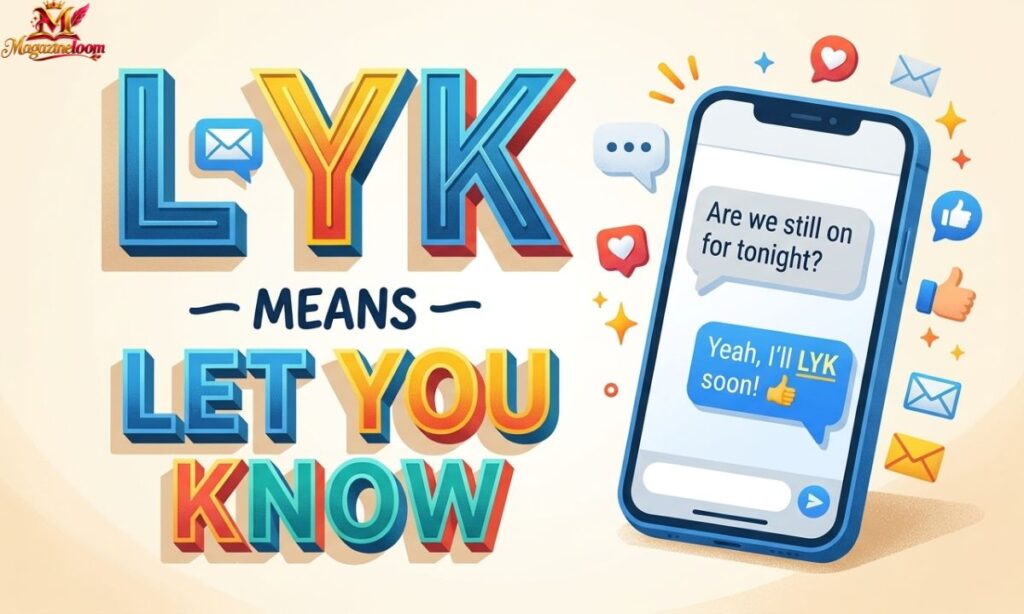
The LYK meaning depends on where you see it. Most often, it is short for “like.” Sometimes, it also means “let you know.” The words around it will give you a clue.
You get a message that says, “I’ll lyk tonight.” You pause. Is that a typo? Is it short for something?
It is short for something. LYK usually means “let you know.” In some chats, especially older or very casual ones, it can also be a quick spelling of “like.”
This guide explains both meanings, shows how people use LYK on WhatsApp, Instagram, Snapchat and TikTok, and tells you when to use it and when to skip it. You will also find sample replies, similar slang, and answers to common questions.
Quick Overview Table
| Detail | Answer |
| Abbreviation | LYK |
| Main meaning | Let you know |
| Other meaning | Like (casual spelling) |
| Common variation | ILYK (I’ll let you know) |
| Tone | Casual, friendly, quick |
| Best used on | Text, WhatsApp, Snapchat, Instagram DMs, TikTok chats |
| Formal use | Not recommended |
| Example | “Got a meeting at 3. Will lyk after.” |
What Does LYK Mean in Text?
In most texts, LYK stands for “let you know.” It tells the other person you will share information later.
Here are a few quick examples:
- “Not sure about dinner yet. I’ll lyk.”
- “Checking my schedule, lyk soon.”
- “Lyk when you reach.”
Notice that the word is almost always tied to a promise. The sender is saying, “I don’t have the answer right now, but you’ll hear from me.”
The second meaning is “like.” Someone might write, “It was lyk so cold today.” Here, LYK is just the filler word spelled the way it sounds. You will see this less often today, and mostly in very casual or playful messages.
LYK Meaning in Chat Conversations

Chat is fast. People type with one thumb, switch apps, and reply between other tasks. LYK fits that rhythm because it saves a few seconds and still sounds natural.
In chat, LYK works like a small placeholder. It keeps the conversation open without forcing you to give a full answer right now.
Compare these two replies:
- “I will inform you about my availability once I check my calendar.”
- “Checking my calendar, lyk.”
Same message. The second one feels like how people actually talk online.
LYK as “Let You Know”
This is the meaning you will meet 90% of the time, so it helps to know how it behaves in a sentence.
LYK can appear in three common patterns:
- Promise: “I’ll lyk once I’m free.”
- Request: “Lyk if you need anything.”
- Update: “Just lyk, the train is late.”
The first two are the most common. The third works like a heads-up, similar to “just so you know.”
Quick tip:
If you can swap LYK with “let you know” and the sentence still makes sense, that is the meaning.
LYK in Ongoing Conversations
LYK often shows up in the middle of a back-and-forth, not at the start. Think of plan-making chats, where answers depend on other things.
For example:
- Friend: Are you coming Saturday?
- You: Maybe. Waiting on my shift schedule. Lyk tomorrow.
Here, LYK pauses the topic and sets a clear time to pick it up again. That keeps the other person from wondering whether you forgot.
If you use LYK like this, try to attach a rough timeframe. “Lyk tonight” works better than a lone “lyk,” because it gives the other person something to hold on to.
LYK Meaning on Social Media Platforms

Social platforms don’t change what LYK means. They change how fast people type and how casual the tone is. On apps built around quick messages and short videos, LYK is common in direct messages and comment replies.
Here is how it differs from app to app.
LYK on WhatsApp
WhatsApp is used for everything from family chats to work updates. LYK appears mostly in plan-making and in replies like “will lyk.”
Because WhatsApp is used by older and younger people alike, some readers may not know the term. If you message a relative or a new contact, spelling it out is safer.
LYK on Instagram
On Instagram, LYK lives mostly in DMs and story replies. Someone might reply to your story with “Where is this? Lyk if you have the link.”
In public comments, it is much rarer. Comments tend to use reactions, emojis and “link?” instead.
LYK on Snapchat
Snapchat chats are quick and casual, so LYK fits well. Friends use it for meetups: “Lyk when you’re outside.”
Since many Snapchat messages disappear after viewing, people lean on short phrases that are easy to type and easy to read in a glance.
LYK on TikTok
On TikTok, LYK appears in DMs and sometimes in comment threads. A creator might reply, “Part 2 coming soon, will lyk.” Fans also use it when they ask for updates.
It is still far less common than platform-native slang. Most TikTok comments lean on other terms, so LYK feels more like a texting habit that travels with people.
Why People Use LYK in Texting
People use LYK for simple reasons:
- Speed. Three letters beat three words.
- Tone. It sounds relaxed, not stiff.
- Habit. Texting shorthand became normal over years of use.
- Low pressure. It lets you respond without giving a full answer.
There is also a social reason. Writing “I’ll let you know” can feel a bit serious. “Lyk” feels lighter, which suits friendly chats.
Understanding LYK Based on Context
Context is how you tell the two meanings apart. Look at where the word sits in the sentence.
| Sentence | Meaning | Why |
| “I’ll lyk tomorrow.” | Let you know | Follows “I’ll,” points to future info |
| “Lyk if you need help.” | Let you know | Used as a request |
| “That was lyk so funny.” | Like | Works as filler before “so” |
| “It looks lyk rain.” | Like | Replaces “like” as a comparison |
If the message talks about plans, news or waiting, it means “let you know.” If it sounds like casual speech or a comparison, it means “like.”
When it is still unclear, ask. A quick “Lyk as in let you know?” is better than guessing wrong.
Best Time to Use LYK in Texting
LYK works best when:
- You are making plans with friends or family.
- You are waiting for information and can’t answer yet.
- The conversation is relaxed and quick.
- You want to promise an update without a long message.
It works worst in serious talks, emotional chats, or anything that needs a clear, complete reply. We will cover that in more detail later.
LYK vs Other Similar Slang
LYK sits in a small family of “I’ll get back to you” phrases. Here is how they compare.
| Slang | Meaning | Tone | Difference from LYK |
| LYK | Let you know | Casual | Promises info or update |
| BRB | Be right back | Casual | Short break, you return soon |
| TTYL | Talk to you later | Casual | Ends the chat for now |
| GTG | Got to go | Casual | Signals you are leaving |
| IDK | I don’t know | Casual | Admits no answer |
| FYI | For your information | Neutral | Shares info, no promise |
| HMU | Hit me up | Casual | Invites contact |
The main difference: LYK is about information, not about your presence. You can say it and stay in the chat.
Psychological Effect of Using LYK
Short phrases change how a message feels. LYK can do three things.
It calms uncertainty. When someone says “I’ll lyk,” the other person knows an answer is coming. That is more reassuring than silence.
It sets an expectation. A promise, even a small one, creates a mental timer. If you say “lyk tonight” and never follow through, the other person notices.
It softens a “no answer yet.” Saying “I’m not sure” can feel like a dead end. Adding “will lyk” makes it feel like progress.
The flip side is that LYK can feel vague. If it is used again and again without a follow-up, the reader may start to feel ignored.
Cultural Importance of LYK
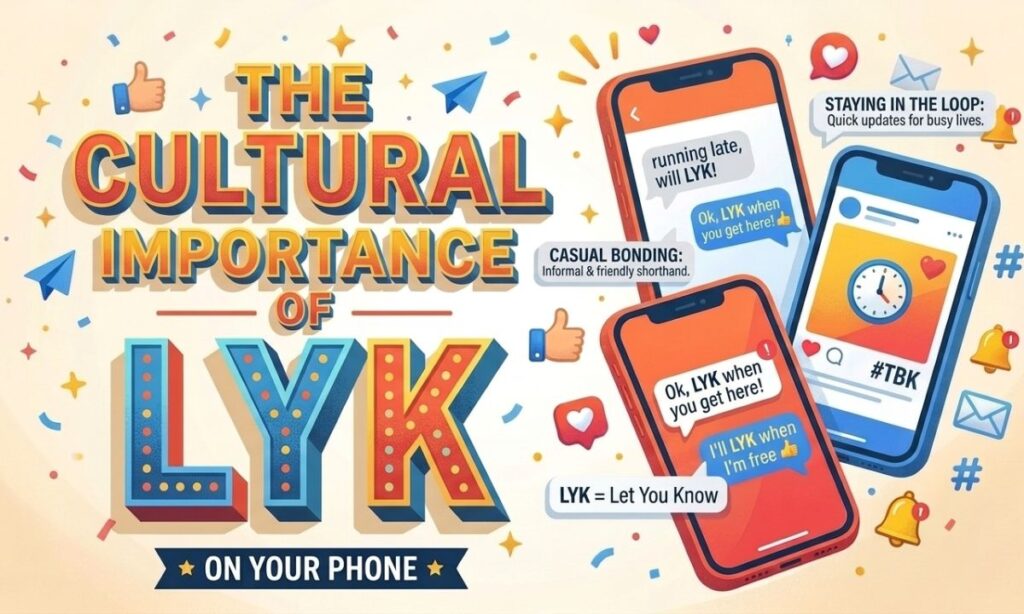
LYK belongs to a long tradition of text shorthand, born when messages were short and typing was slow. Over time, people kept the abbreviations even after the limits went away, because they had become part of how friends talk.
Shorthand like this works as a kind of social code. Using it signals that you are comfortable, informal and on the same wavelength as the person you are chatting with.
Language researchers have long noted that texting styles shift by age group, region and platform. LYK is a small example of that. It is familiar to some groups and unknown to others, and that gap is normal.
How LYK Helps Increase Engagement
In casual chats and DMs, LYK keeps conversations alive. It does this in a few ways:
- It leaves a door open. The other person knows to expect a follow-up.
- It invites a reply. “Lyk if you’re interested” nudges people to respond.
- It keeps replies short. Short messages are easier to answer.
For creators and small brands who chat with followers in DMs, a friendly “will lyk!” can feel more human than a stiff template. Just make sure you do follow up.
Different Ways to Reply to LYK in Text
How you reply depends on the situation. Here are simple options.
Casual replies:
- “Sounds good!”
- “Cool, thanks.”
- “No rush.”
- “Ok, waiting.”
When you need a time frame:
- “Any idea when?”
- “Can you lyk by tonight?”
- “Let me know by 5 if you can.”
When you want to move on:
- “No worries, I’ll go ahead without.”
- “All good, ping me if it changes.”
Playful replies:
- “Don’t leave me hanging 😄”
- “Waiting patiently…”
Match your reply to your relationship. With a close friend, a short joke is fine. With a new contact, a polite “Thanks, talk soon” is safer.
Common Variations of LYK
You may see these spin-offs in chats:
| Variation | Meaning | Example |
| ILYK | I’ll let you know | “ILYK once I land.” |
| WLYK | Will let you know | “WLYK about Friday.” |
| LMK | Let me know | “LMK if you’re free.” |
| Lyk | Like (casual) | “It was lyk amazing.” |
| Lyk u | Let you know (spelled loose) | “Lyk u later.” |
A small warning on LMK. It is the reverse of LYK. LMK asks the other person to tell you something. LYK says you will tell them. Mixing these up is a very common slip.
LYK in Group Chats vs Private Chats
The setting changes how LYK lands.
In group chats, LYK can feel public. “I’ll lyk” tells everyone you will update the whole group. It is useful, but it also puts a spotlight on you. If you forget, many people notice.
In private chats, LYK is more personal and relaxed. A one-to-one “lyk later” feels like a quiet promise between two people.
Some small habits help:
- In groups, say what you will update on: “Will lyk about the venue.”
- In private, keep it short and warm.
- In both, follow up, even if the answer is “still waiting.”
Is LYK Still Relevant in 2026?
Yes, but in a modest way. LYK has not disappeared. It still shows up in quick messages and DMs, though it is not a headline trend.
Voice notes, emojis, GIFs and voice-to-text have changed how many people message. Some now just write the full phrase because their phone fills it in. Others prefer newer slang.
Still, texting shorthand tends to stick around because it is useful. LYK is simple, clear and quick, so it is likely to stay in casual use, even if it never gets loud.
How LYK Reflects Digital Communication Trends

LYK tells a small story about how people write online:
- Speed matters. People want short, quick replies.
- Tone matters. Casual beats formal in most chats.
- Clarity still counts. Shorthand survives when it is easy to understand.
- Context carries meaning. The same letters can mean different things.
It also shows a split many people feel: the pull between being quick and being clear. LYK sits right in that gap.
The Evolution of LYK in Digital Communication
Text shorthand began in the early days of SMS, when messages had tight limits and many phones made typing slow. People shortened words to fit and to save effort.
Phrases like “let you know” were natural targets. They are common, easy to compress, and said many times a day.
As chat apps replaced SMS, the limits faded, but the habit stayed. Shorthand moved from a need to a style. Today, LYK is less about saving characters and more about sounding casual.
Common Mistakes People Make When Using LYK
Avoid these slip-ups:
- Using it with the wrong audience. A boss, client or older relative may not know it.
- Forgetting to follow up. A “lyk” with no update feels like a brush-off.
- Mixing it up with LMK. The direction of the promise is opposite.
- Using it with no time frame. “Lyk” alone can feel vague.
- Overusing it. If every reply is “lyk,” the chat starts to feel evasive.
- Ignoring the “like” meaning. Sometimes it really is just “like,” and reading it as a promise causes confusion.
Difference Between LYK and BRB in Texting
These two get confused because both are quick, casual and tied to short gaps.
| Feature | LYK | BRB |
| Full form | Let you know | Be right back |
| What it promises | An update or answer | Your return |
| Typical gap | Minutes to days | Minutes |
| Stays in chat? | Often yes | Usually steps away |
| Example | “Lyk after I check.” | “Brb, door.” |
In short: BRB is about you coming back. LYK is about information coming to them.
How LYK Is Used in Professional vs Casual Chats
Casual chats: LYK is natural here. Friends, siblings and classmates use it freely.
Professional chats:
Be careful. In a work setting, shorthand can look careless, especially with clients, managers or new colleagues. Some very relaxed workplaces and team chat tools are fine with it, but when in doubt, write the full phrase.
| Setting | Okay to use LYK? | Better option |
| Friends | Yes | — |
| Family | Usually | Spell out for older relatives |
| Close coworker (chat) | Sometimes | “Will let you know” |
| Manager | Rarely | “I’ll update you by 3 PM.” |
| Client or email | No | “I will confirm shortly.” |
How LYK Improves Communication Efficiency
When used well, LYK trims friction:
- Shorter messages mean faster back-and-forth.
- Clear promises reduce repeat questions like “any update?”
- Open loops are easier to track when you state them.
Efficiency only works if the message is understood. If you are not sure the reader knows LYK, the time you save can be lost to a confused reply.
Future of LYK in Digital Communication

No one can say for sure where slang goes, but a few trends are clear.
Autocorrect and predictive text are getting better, so full phrases cost almost no effort. Voice messages are growing too. Both could reduce the need for shorthand.
On the other hand, casual tone is not going away. People will keep inventing quick ways to sound friendly and relaxed. LYK may stay as it is, fade slowly, or be replaced by something new. For now, it remains easy to understand and easy to use.
Importance of Understanding LYK
Knowing small terms like LYK pays off in everyday ways:
- You avoid misreading a message.
- You respond with the right tone.
- You can spot when someone is promising an update.
- You keep up with friends without feeling lost.
It is a tiny piece of language, but missing it can lead to awkward moments, like replying to “lyk” as if it were a question.
Role of LYK in Online Conversations
In online chats, LYK plays the part of a soft handoff. It says, “The ball is in my court, and I’ll pass it back soon.”
That role is useful because online talks often get paused. People get busy, switch apps or lose signal. A short “lyk” explains the pause and sets a loose plan for what happens next.
When to Use LYK
Use LYK when:
- You are chatting with friends or close contacts.
- You need time before you can answer.
- You want to keep a message short and light.
- You know the other person understands the term.
- You can realistically follow up.
When NOT to Use LYK
Skip LYK when:
- You are writing to a boss, client or teacher.
- The topic is serious, urgent or emotional.
- The reader may not know slang.
- You are writing formal emails, reports or official messages.
- You cannot promise to follow up.
In those cases, a full sentence is clearer and more respectful.
Similar Slang Terms to LYK
If you like keeping up with chat shorthand, here are a few related terms:
- LMK: Let me know
- ILYK: I’ll let you know
- WLYK: Will let you know
- TTYL: Talk to you later
- BRB: Be right back
- HMU: Hit me up
- IDK: I don’t know
- IDC: I don’t care
- FYI: For your information
- ETA: Estimated time of arrival
Why LYK Is Trending
To be clear, LYK is not exploding in popularity. It shows up in searches because people keep running into it and want to check what it means.
A few reasons keep it in circulation:
- It looks like a typo, so people look it up.
- It has two meanings, which causes confusion.
- Younger users pick up shorthand from friends and social apps.
- People searching for texting slang tend to read many “meaning” guides at once.
LYK Meaning Based on Intent
Why someone writes LYK matters as much as the word itself. The same three letters can sound warm, casual or distant depending on who sends them.
From a Friend:
A friend using LYK is usually being relaxed and friendly. It often means, “I’m still figuring this out, but I’ll tell you soon.”
Example: “Not sure if I can make it. Lyk by 6.”
A friend may also use it to hint they want to hear back: “Lyk if you’re coming!” That is an invitation, not a command.
From Colleague:
A colleague using LYK usually means a quick work update. It signals a short delay, not a brush-off.
Example: “Checking with the team, will lyk.”
Still, because work chats are semi-formal, it can mean different things to different people. If you need a clear deadline, ask for it politely: “Thanks! Can you share a rough time?”
Frequently Asked Questions
What does LYK mean in text?
LYK most often means “let you know.” It tells someone you will share information or an update later.
Does LYK mean “like”?
Sometimes. In very casual messages, LYK can be a quick spelling of “like,” so check the context.
What does “I’ll lyk” mean?
It means “I’ll let you know.” The sender is promising to give you an answer or update later.
What does LYK mean on Snapchat?
On Snapchat it usually means “let you know,” often used when making plans with friends.
What does LYK mean on social media?
On social media, LYK is slang for “like.” It’s used in captions, comments, and DMs to show approval or interest, or as a quick way to say “such as.”
What does LYK mean on WhatsApp?
It means “let you know.” People use it to promise updates about plans, meetings or news.
What does LYK mean on Instagram?
In DMs and story replies, it usually means “let you know.” It is rare in public comments.
What is the difference between LYK and LMK?
LYK means you will tell the other person something. LMK means you are asking them to tell you.
What does ILYK mean?
ILYK means “I’ll let you know.” It is a slightly fuller version of LYK.
Is LYK appropriate for work?
Only in very casual team chats. For managers, clients and emails, write “let you know” in full.
Is LYK the same as BRB?
No. LYK promises an update, while BRB says you will be right back.
How do you reply to LYK?
Keep it simple: “Sounds good,” “Thanks,” or ask for a time frame like “Any idea when?”
Is LYK still used in 2026?
Yes, mainly in casual texts and DMs. It is not huge, but it is still understood by many people.
Can LYK be misunderstood?
Yes. Because it can mean “let you know” or “like,” context is the best guide. If unsure, ask.
Final Thought
LYK is a small word with a simple job. In most chats, it means “let you know,” a quick promise to share news or answers later. In a few casual cases, it is just “like” spelled the way it sounds.
Use it with friends, read the context before you reply, and always follow through when you say it. If you are writing to someone who may not know slang, or in a formal setting, spell it out.
Understanding LYK is a quick win. It helps you read messages correctly, reply naturally and keep your chats clear without losing the relaxed tone people expect online.

Noah is a passionate content writer and language enthusiast who enjoys making difficult words, phrases, and text meanings easy to understand. She creates clear, simple, and useful articles with practical examples to help readers improve their vocabulary and everyday language skills.