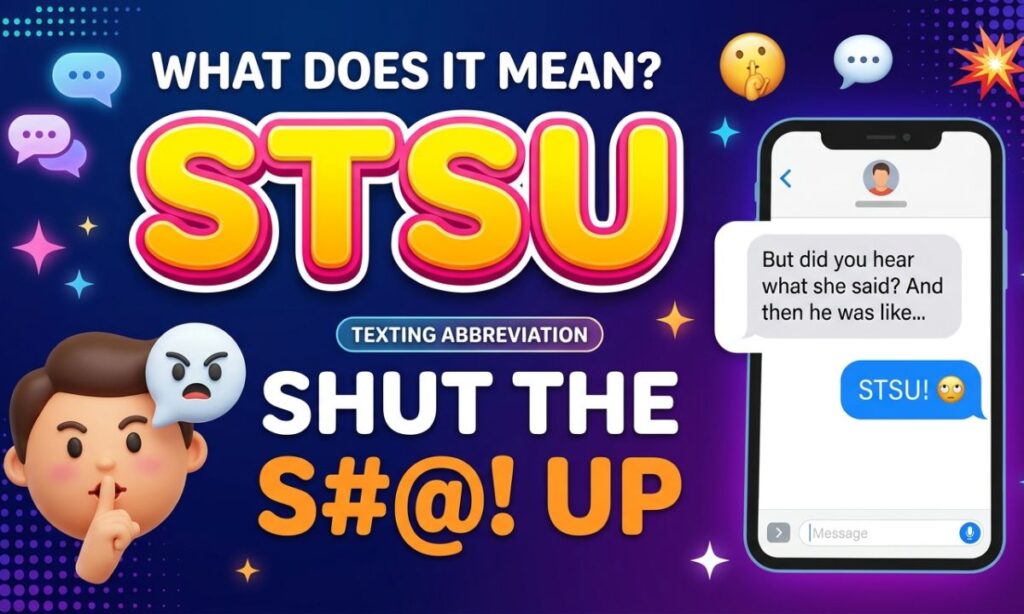
Here’s the short version. STSU is a slang way of telling someone to stop talking, and it sits in the same family as STFU. This guide explains what it stands for, how the tone changes between friends and strangers, and how to reply without making things worse.
You see “STSU” in a text and wonder what it means. You are not alone. This short slang pops up in chats, comments, and DMs. So, what does STSU mean in text? Let’s clear it up.
STSU stands for “shut the f*** up.” People use it when they want someone to stop talking. It can sound rude, so tone matters a lot. Friends may use it as a joke, but it can also be a real insult.
You will mostly see STSU in casual chats on Instagram, Snapchat, and TikTok. A friend might send it after a funny story or a shocking secret. Below, you will find the full meaning and easy examples to use it the right way.
Quick Answer
STSU means “shut the s* up.”** It’s a blunt, informal way to tell someone to be quiet. Between close friends it can be a joke or a reaction to something shocking. From a stranger, or in the middle of an argument, it’s rude.
Some people also type it by accident while aiming for STFU, since the S and F keys sit close together on a keyboard. That’s a typing explanation, not a documented origin, so treat it as a likely reason rather than a fact.
Quick Overview Table
| Detail | Info |
| Slang term | STSU |
| Most common meaning | Shut the s*** up |
| Closest relatives | STFU, STHU |
| Tone | Blunt, informal, often rude |
| Can be playful? | Yes, between close friends |
| Common platforms | Snapchat, Instagram DMs, TikTok comments, WhatsApp, Discord |
| Safe for work or school? | No |
| Polite alternative | “Give me a second,” “Let me think,” “Please stop” |
What Does STSU Mean in Text?
STSU is an acronym for a rude command: stop talking, now. The “S” at the end stands for a mild-to-strong swear word, which is why the term feels sharp even when it’s shortened.
It’s usually written in lowercase and sent fast. That’s part of its flavor. It’s meant to look quick and unfiltered, not carefully worded.
The meaning stays the same in most chats. What changes is the intent behind it, and we’ll cover that in detail below.
STSU Full Form and Where It Came From
The slang family around this term is well documented, even if STSU itself rarely appears in formal dictionaries.
Merriam-Webster lists STFU as an informal, sometimes offensive way to say “shut the f*** up,” used especially in texts or posts. How-To Geek notes the earliest Urban Dictionary entry for STFU dates to July 2003. So the pattern of shortening this phrase has been around online for over two decades. merriam-websterhowtogeek
From there, people started swapping letters. STHU, for example, is listed as slang for “shut the hell up,” a slightly milder form of the same idea. STSU follows that same logic: keep the “ST_U” frame and change the middle word. calendar-uk
A practical point worth knowing: because STSU isn’t in major dictionaries, there’s no single official definition. Be careful with websites claiming it stands for something cheerful. Some pages online assign it meanings like “So That’s Something Unique,” but that doesn’t match how people actually use it in chats. If the message came with an annoyed or joking tone, the “shut up” reading is almost always the right one.
STSU Meaning in Chat Conversations

In a one-on-one chat, STSU works as a reaction word. It can mean “stop talking,” “stop joking,” or “no way, are you serious?” The words are the same. The mood isn’t.
Playful Usage (Among Friends)
With close friends, STSU is often affectionate teasing. Someone shares good news, tells an unbelievable story, or sends a flattering compliment, and the other person fires back “stsu.”
In this case it doesn’t mean “be quiet.” It means “stop, that’s too good” or “I can’t believe it.” You’ll often see laughing emojis, extra letters, or exclamation marks around it.
Signs it’s playful:
- A smiley, laughing, or crying-laughing emoji follows it
- It’s a reply to a compliment or surprising news
- The two people joke with each other all the time
- The message is short and light, with no follow-up insult
Serious Usage (Argument or Annoyance)
In an argument, STSU is a shutdown. The sender is tired of the conversation and wants it to end.
Signs it’s serious:
- It arrives after a heated back-and-forth
- It’s in all caps, such as “STSU”
- There’s no emoji, or an angry one
- Other harsh words appear in the same message
- The sender stops replying afterward
One parental-guide site on STFU points out that all caps, rather than lowercase, signals a higher level of anger. The same pattern tends to hold for STSU. Lowercase feels casual. Capitals feel loud. mmguardian
STSU Meaning on Social Media Platforms
The core meaning doesn’t change by app, but each platform has its own habits.
Snapchat
On Snapchat, STSU shows up in quick chats and replies to snaps. Because messages disappear fast and feel casual, it’s usually used jokingly. A friend replies “stsu” to a funny snap or an unbelievable story.
Outside a friendly circle, a stranger sending it on Snapchat is more likely being rude or trying to provoke you.
On Instagram, you’ll see it in DMs, story replies, and comment sections. In DMs between friends, it’s often a joking reaction to a photo or story. In public comments, it leans more hostile, especially when it’s aimed at someone’s opinion.
If an unknown account replies to your post with “stsu,” read it as dismissive. You don’t owe it a response.
WhatsApp chats tend to include family, coworkers, and friends in the same app. That mix makes STSU risky. It might land fine in a friend group chat and badly in a group with relatives or colleagues.
In a group chat, a “stsu” can also embarrass the person it’s aimed at, because everyone sees it.
TikTok
On TikTok, STSU appears in comments under videos. It’s used as a reaction (“stsu, that’s amazing”) and as a put-down aimed at creators or other commenters. Reading the comment thread around it usually makes the intent clear. A pile of laughing emojis points to humor. A string of insults points to a fight.
Why People Use STSU in Texting

People reach for it for a few simple reasons.
- Speed. Four letters beat typing a full sentence.
- Emphasis. It sounds sharper than “be quiet.”
- Shock value. The edge of the original phrase gets attention.
- Group identity. Using the same slang as your friends makes chats feel casual and close.
- Softening the swear. An acronym feels a little less harsh than writing every word, even though everyone knows what it stands for.
That last point matters. Many people feel the letters take the sting out of the words. The person receiving it often doesn’t agree.
Understanding STSU Based on Context
When you’re unsure, check four things before reacting.
Who sent it?
A best friend and a stranger can send the exact same letters and mean very different things.
What came right before it?
If you just shared a funny story, it’s likely a joke. If you just disagreed about something serious, it’s likely a shutdown.
How is it written?
Lowercase with emojis feels light. Capitals and punctuation feel angry.
What happens next?
If the sender keeps chatting normally, it was casual. If they go silent or send more hostile messages, it wasn’t.
Here’s a quick reference:
| Situation | Likely meaning |
| Reply to good news, with laughing emoji | “No way!” or “Stop, that’s amazing” |
| Reply to a joke between friends | Playful teasing |
| After a long argument | “I’m done listening” |
| From a stranger in comments | Rude or trolling |
| In all caps with no emoji | Angry |
Real-Life Usage Examples
These are made-up sample chats to show how the tone shifts.
Example 1
Friend A: I just got front-row tickets for Saturday.
Friend B: stsu 😭 you’re so lucky
Meaning: Excited disbelief. Nothing rude here.
Example 2
Person A: You never listen to me, honestly.
Person B: And you never stop complaining.
Person A: STSU
Meaning: A real shutdown. A has had enough and wants B to stop.
Example 3
Commenter 1: This song is overrated lol
Commenter 2: stsu this is the best track on the album
Meaning:
Mild annoyance mixed with strong opinion. It’s a heated reply, but not necessarily a personal attack.
When to Use STSU
There’s a narrow set of situations where it works.
- With close friends who joke in the same style
- As a playful reaction to shocking or flattering news
- In relaxed private chats where nobody will be offended
- When you’re sure the other person knows you’re kidding
Even then, a laughing emoji helps. It removes doubt about your tone.
When NOT to Use STSU
Skip it in these cases:
- Work emails, Slack messages, or any professional chat
- School messages, teacher or parent chats
- Messages to family elders or people you don’t know well
- Serious conversations, grief, or conflict
- Group chats with mixed audiences
- Any situation where you’d feel uncomfortable if a screenshot were shared
A simple test: if you wouldn’t say the full phrase out loud to that person, don’t text the acronym.
Similar Slang Terms to STSU
STSU belongs to a larger group of “stop talking” slang. Here are the common ones.
- STFU – the best-known version, and the harshest of the group
- STHU – “shut the hell up,” a little milder
- Shut it – a short, less profane command
- Shush / Shh – gentle, sometimes playful
- Zip it – casual and slightly humorous
- SYBAU – a newer, vulgar variant that circulates in some online circles
- GTFO – “get the f*** out,” which also doubles as a “no way!” reaction
The more letters that stand for a swear word, the stronger the message tends to feel.
Why STSU Is Trending
I couldn’t find reliable data on search volume or growth for STSU, so I won’t claim exact numbers. What I can say is why this kind of slang keeps spreading.
Short-form chat apps reward fast replies. People type in fragments, drop punctuation, and invent small spelling changes that become inside jokes. Variants of STFU are a natural fit because they’re easy to remember and easy to remix.
Whenever a slang term gets a new letter combination, people search for it. That’s likely why “what does stsu mean” keeps showing up as a question: the term looks familiar but isn’t in any dictionary they know.
Tone Matters: How STSU Can Change Meaning
The same four letters can carry very different messages.
| Delivery | What it says |
| “stsu 😂” | You’re hilarious / I can’t believe it |
| “stsu!!” | Strong reaction, could be either |
| “STSU” | Angry, serious |
| “stsu.” (with a period) | Cold, annoyed |
| “stsu” after a pause or silence | Hard to read; ask |
Punctuation, capitals, and emojis do the work that tone of voice would do in person. Without them, you’re guessing.
Psychological Impact of Using STSU
Words like this land differently depending on the listener. A person used to rough banter may shrug it off. Someone sensitive to being dismissed may feel hurt, even if it was meant as a joke.
Being told to be quiet can feel like being told your thoughts don’t matter. That’s true even in text, where you can’t hear a laugh or see a grin. Over time, using it in serious conversations can damage trust, because the other person learns that you shut them down instead of listening.
On the other side, people who use it often within friend groups may treat it as harmless habit. The gap between sender and receiver is where most misunderstandings begin. If you notice someone going quiet after you send it, check in.
Is STSU Always Offensive?
No. It’s often offensive, but not always.
Between friends who tease each other, it works as a reaction word, like saying “shut up!” when someone tells you amazing news. The meaning comes from the relationship, not just the letters.
Still, the default reading is rude. If you’re not sure the other person will take it well, don’t send it. And if you receive it and aren’t sure how it was meant, don’t assume the worst until you check the context.
How to Respond to STSU in a Conversation
Your reply depends on what you think the sender meant.
If it’s playful: Match the energy. “Haha it’s true though” or a laughing emoji works fine.
If it’s unclear: Ask directly. “Wait, joking or are you actually annoyed?” This takes the pressure off and keeps things honest.
If it’s angry: Pause. Don’t answer in the heat of the moment. You can say, “Okay, let’s talk about this later.”
If it’s from a stranger or troll: Don’t engage. Mute, block, or report if it crosses into harassment.
If it’s constant or hostile: Save screenshots, and tell a trusted adult or the platform’s support team, especially for younger users.
STSU vs Other Strong Slang Terms
| Term | Meaning | Strength |
| Shh / Shush | Be quiet | Gentle |
| Shut it | Stop talking | Mild |
| STHU | Shut the hell up | Medium |
| STSU | Shut the s*** up | Medium-strong |
| STFU | Shut the f*** up | Strong |
| SYBAU | Vulgar, personal command | Strong |
The ranking is my own rough read of how each term tends to feel in conversation. It’s not an official scale, and tone still matters more than the letters.
How STSU Reflects Modern Communication Trends
Slang like this shows a few clear patterns in how people chat.
First, brevity wins. People trim every message, and shortened phrases spread quickly.
Second, tone has to be rebuilt with symbols. Emojis, caps, and punctuation replace the voice and face we’d use in person.
Third, language splits by audience. The same person may text “stsu” to a friend and write a formal email to a boss without thinking twice. People switch registers constantly.
Fourth, new variants appear all the time. A single base phrase like STFU produces dozens of spin-offs, each trying to feel fresh or slightly less harsh.
Tips for Using STSU Safely in Texting
- Know your audience. Use it only with people who joke the same way.
- Add a tone marker. A laughing emoji makes the intent clear.
- Avoid it in disagreements. It shuts conversations down instead of solving them.
- Don’t use it in group chats with mixed ages or roles.
- Think about screenshots. Anything you send can be shared.
- Stop if the other person seems hurt. Apologize and move on.
- Keep a cleaner option ready. “No way!” and “Stop, you’re too funny” do the same job for most cases.
Common Mistakes When Using STSU
- Sending it to the wrong person. Jokes with friends can look aggressive to coworkers or relatives.
- Using it as an argument-winner. It ends the discussion but doesn’t answer anything.
- Relying on lowercase to sound soft. Lowercase helps, but the words are still harsh.
- Assuming everyone knows it. Some people have never seen it and will misread it.
- Guessing meaning from random websites. As noted above, some pages invent harmless definitions that don’t match real usage.
- Ignoring the reaction. If someone goes cold after you send it, that’s feedback.
Does STSU Have Other Meanings?
Possibly, in narrow settings. Abbreviation lists show that three- and four-letter combos get used for school names, organizations, and technical terms. In a casual chat on a social platform, though, STSU is almost always the “shut up” slang.
If you see it in a very different context, like a university email or a company document, it may be a name or code. Check the surrounding text. When it appears in a chat reply with attitude, the slang meaning applies.
Is STSU Used Worldwide?
It’s mostly seen in English-language chats, but online slang travels across borders fast. English-speaking teens and young adults in many countries use STFU-style terms, especially on platforms like Snapchat, TikTok, and Discord.
I couldn’t find a reliable breakdown by country, so there’s no honest way to say where it’s most common. What’s clear is that people who speak other languages tend to have their own local versions of the same idea, and those often sit alongside English abbreviations in mixed-language chats.
How STSU Compares to Polite Alternatives
If you want the same effect without the bite, try one of these.
| Instead of STSU | Try this | Best for |
| stsu (joking) | “No way!” | Reacting to news |
| stsu (joking) | “Stop, you’re too funny” | Friendly teasing |
| stsu (annoyed) | “I need a minute” | Cooling down |
| stsu (annoyed) | “Can we talk about this later?” | Heated chats |
| stsu (tired) | “I’d rather not discuss this” | Setting a boundary |
| stsu (to a troll) | Block or mute | Online harassment |
These keep your point clear and leave the relationship in better shape.
Frequently Asked Questions
What does STSU mean in text from a girl?
It usually means “shut the s*** up,” used jokingly if she’s teasing or flirting, or seriously if she’s upset. Check the emojis and what you said just before.
What does STSU mean in text from a guy?
It means the same thing: a blunt “shut up.” Between friends it’s often banter, and in an argument it signals he’s done talking.
What does STSU mean in text on Instagram?
On Instagram, it’s a slang reaction in DMs, story replies, or comments. It can be playful with friends or dismissive from strangers.
What does STSU mean on TikTok?
On TikTok, it appears in comments as either a shocked reaction (“stsu, that’s amazing”) or a put-down aimed at someone’s opinion. The tone of nearby comments helps you decide.
What does STSU mean on Snapchat?
On Snapchat, it’s mostly a casual, joking reply among friends. From someone you don’t know, it’s more likely rude.
What does STHU mean in text?
STHU is internet slang for “shut the hell up,” an emphatic form of “shut up.” It’s a bit milder than STFU and works much like STSU. calendar-uk
Is STSU rude?
Usually, yes. It’s only friendly when both people clearly share a joking style.
Can I use STSU at work or school?
No. Keep it out of professional and school messages.
Final Thought
STSU is a small piece of slang with a big range of tone. At its core it means “shut the s*** up,” a blunt cousin of STFU. Among close friends it can be a laughing reaction. In a fight or from a stranger, it’s a shutdown.
When you receive it, read the context before you react: who sent it, what came before, and how it’s written. When you want to send it, ask yourself whether the other person will hear a joke or an insult. If you can’t tell, choose a softer phrase. A few extra words cost nothing, and they keep chats friendly.

Noah is a passionate content writer and language enthusiast who enjoys making difficult words, phrases, and text meanings easy to understand. She creates clear, simple, and useful articles with practical examples to help readers improve their vocabulary and everyday language skills.